Sunday, September 09, 2007


The Christian basis for human social progress – Part 1
Progressive zealots bite the hand that feeds them
Many who claim to be devoted to the ideals of human progress are unknowingly chipping away at the very foundation upon which those ideals rely. As anti-religious zealots attack all public acknowledgement of any principle or symbol that is tied to religion, they are undermining the philosophic underpinnings that allow them the freedoms they take so much for granted.
A couple years ago (2003) a young man filed a lawsuit against the city where I live, Everett, Wash., to force the removal of a stone monument that depicted the Ten Commandments. The monument is a 6-foot, engraved granite slab that stands near the entrance to a city office building. It was paid for and placed there in 1959 by a local fraternal organization. See news story.
The young man, Jesse Card, seemed to be arguing that, because the Ten Commandments represent the religious traditions of Jews and Christians, the monument serves to promote those religions and, by being on public property, violates the constitutional prohibition on government establishment of religion. The arguments in this and other such cases focus on the basic principals of individual autonomy established in the U.S. Constitution (1788) and Bill of Rights (1791).
Of course the idea that individual freedom could not be trumped by monarchs or states was not invented in America. The Magna Carta limited the power of the English king, basing those limits on the notion that the law applies to all, due to the equal dignity of the individual under God. Again, this concept of kings being subject to higher laws was not new in the Christian West. From Constantine to Charlemagne, monarchs had humbled themselves before the God of David and Moses.
It is, in fact, the Law of Moses that began the revolution that gives the young man in Everett the right to free speech, to sue the government, to observe his own religion or no religion at all. The Hebrew innovation that would help shape Western law and politics is the idea that even Moses was not above the Law that bears his name. Even King David was culpable under Hebrew law for his transgressions. This was a radical departure from all ancient civilizations for whom the ruler was the law and “might made right.” It is still a radical idea in non-Westernized nations. Why? Because without the cultural influence of Christian thought, it does not occur to the human mind.
The irony of the lawsuit in Everett was that the limited view of the monument as a religious symbol seemed to blind this zealot for individual rights to its much larger significance as a symbol of human rights that transcends the whims of individuals to control the freedoms of others. For unless there is an acknowledgement that ALL individuals are equal under a higher law, then the way is open for an elite class of individuals to claim sovereignty over everyone else. Our system of law and justice can only respect all equally because it requires all individuals to extend equal respect to everyone else. And those concepts come from where? The law of Moses, symbolized by the Ten Commandments.
I might point out as an aside that the concept of division of church and state can be seen in the ancient Jewish and Christian tradition of showing the commandments related to our duty to God on one tablet and those related to our duty to other people on the second tablet. Those tablets are very rich symbols that the basic concepts of liberalism are not modern innovations, but are rooted in a unique ancient innovation.
Mr. Card stirred up a great deal of vitriol by those who interpreted his lawsuit as an attack on their religion and values. Their response was to condemn his action as anti-Christian bigotry. I thought that was an unfortunate reaction. I do not know what Mr. Card’s real motives were, but I will take him at his word that it was to protect individual liberty as demanded by our Constitution. I felt that the best argument against his action was that it was internally inconsistent to defend one liberty, guaranteed in one document, by dismissing the philosophic pillar holding up that liberty by seeking to drive all symbols of its origin from the public square.
This episode is just one example of the so-called progressives battling against all appearances of religious symbols and concepts in public in the name of basic human rights principles, without realizing that by doing so, they are undermining the very foundation of those principles.
Before going any further, it is important to articulate some of the key progressive ideals we are talking about:
- Individual human dignity and equality under the law based upon that dignity
- Basic rights of the individual to self-determination in their life and property
- The belief that social, economic and technological improvement (progress) is possible and good
A moral value – or even an imperative – to work for progress, not just in our own life, but in the lives of others
I will not attempt to argue that these are key “progressive” ideals. I will take that as a given (until I hear from someone who disagrees). I would point out only that the first two are philosophical imperatives of modern democracy. What bears examination, however is the origins of these concepts in Judaism and their blossoming in Christianity, because I think that THIS idea may not have occurred to many progressives.
In fact, many progressive thinkers resist or even harbor hostility to Christianity and Christian institutions. Apparently in ignorance of the fact that these ideals were sown and nurtured only in the unique World View that emerged from the Judeo-Christian religious experience and its resulting philosophic mind-set, a mindset commonly referred to as “Western Civilization.” Recently, there have been a number of popular books following this theme. Examples include: The God Delusion by Richard Dawkins and God is not Great by Christopher Hitchens.
More disconcerting than their apparent ignorance, is the prospect that anti-Christian progressives will continue to drive anything openly religious (at least openly Christian or Jewish) out of the public square and thus out of the culture. Their “success” in this endeavor would have the predictable consequence of burying any hope that those espoused values could survive in the public square and the new “reformed” culture. Essentially, their hostility to Christian values, virtues and culture, is a rejection of Western Civilization itself. And I will argue that the attack on Western culture – if it ever succeeds – could only result in a replacement culture that will have little or no use for the basic “progressive values” mentioned above.
The first phase of this discussion will begin in part two of this series where I will explain how Christian philosophy led Western society to the basic fundamentals of modern liberal thinking on human dignity and rights and on the roles of social institutions to serve people, rather than the other way around. I will also show how these values cannot be sustained in a culture that rejects the basic philosophical assumptions upon which they rest. For, indeed, the hope of social, economic and technological progress is based upon Christian ideals.
Finally, in part three of this series, I will attempt to understand why so-called “progressives” seek to undermine the very foundation of their espoused values. I will explore a couple of possible motives. I think that some (probably most) truly believe in the ideals but are foolishly ignorant of the historic and philosophic origins of those same ideals. They are easily misled by notions that religion (particularly Christianity) is anti-progress and even barbaric. But I believe there are others who hold a “progressive agenda” that has nothing to do with embracing liberal values of human dignity and progress. It is an agenda that requires a deliberate effort to eliminate Christianity for the very fact that it opposes human dignity and progress. I will discuss what this agenda is and why they must hide the origin of the progressive ideals to create a “progressive” smoke-screen to lend moral legitimacy to what is really a frightening – and quite un-progressive – future society.
(Coming installments)
Part 2:
How did Judaism and Christianity lead to the philosophic framework that enables Western democracy and social and economic freedom?
Part 3:
Why do “Progressives” seek to undermine the values of Western culture (thus undermining Christianity, democracy and human rights?)
Friday, August 31, 2007
Morality Salad
I’ve been thinking about a lot of little topics, nothing huge or terribly pressing, but always buzzing there in the background of my consciousness. Summertime has also imposed certain burdens on my time which have hampered my ability or opportunity to write anything new. Summer also tends to be a busy time at work (where many, even most, of my ideas usually have time to germinate and sprout), so I’ve had to spend more energy focusing on the mundane tasks of the job rather than doing the more mentally satisfying work of theology, philosophy and social analysis.
The things I’ve been mulling over constitute a varied jumble, a salad if you will, of topics concerning morality as it relates to business culture, economics and other social and political concerns. The “global economy”, war, the legal vs. moral status of the family in society, contemporary American culture and the “religion” of secular materialism are among the topics in the mix. (I suspect that there is more than just greens and vegetables in there, so maybe it’s more like a “taco salad” with a little spicy beef mixed in as well.)
(By the way, if any of you have any suggestions for a topic for this blog, any topic, feel free to leave a comment and tell me about it. If I find your idea interesting, I’ll give it some thought and write something …)
In any event, I hope to develop something soon that is worth posting, so check back every so often. Also, I’m still waiting for word from my “guest contributor” who it seems has even less time for writing than I do.
In the meantime, feel free to peruse my older posts and browse through the archives (linked on the gray sidebar) for the ones that have dropped off this main page. Don’t be shy—leave new comments there too, if you wish, but if you do, be sure to leave a “flag” message in the most recent post’s comment box directing my attention to the right place.
Sunday, May 20, 2007
The saddest thing I ever heard
But of all the tragedies I hear reported, or hear from the mouths of friends and acquaintances, by far the SADDEST thing I ever hear is, “I used to be Catholic”.
“WHAT!??” you may ask, “Are you saying that someone’s choice of RELIGION is more important than someone dying of cancer, whole cities being wiped out by tsunamis and hurricanes, the bombs of war and terrorism, and innocent children being killed??”
Yes, I am saying that.
I have said many times that religion (the way we understand and approach God and how we treat other people) is the most important thing in the world. Everyone has to die sometime, and it can be either quick or slow, self-induced or at the hand of someone else (either by intent or accident), by disease or by some other unexpected and unavoidable process or event (the details aren’t that important). And of course, “he who dies with the most toys” is still dead and leaves all his toys behind.
Suffering is an unavoidable part of life. The difference between happiness and misery isn’t whether or not you suffer (or what the particular things are that cause you to suffer), rather it is how you suffer (i.e. how you choose to deal with the suffering that comes your way, and where you find the strength to help you endure it). Sometimes people truly suffer needlessly, such as when they suffer loneliness or alienation because they are so self-absorbed that they refuse to love anyone else, but usually suffering has a way of finding us all by itself.
So everyone suffers and everyone dies. (I’m not trying to be callous, just putting things into perspective, showing you the “Big Picture”.) When a person dies, he faces a personal Judgment before God that determines where he spends eternity. (Next to eternity, our time and suffering on earth are nothing.) The main focus of this Judgment is whether or not you loved and served God in this life (or at least did the best you could with the natural reason God gave you (cf. Rom 2:13-16)). Those who truly loved God in life (not just pretending to) will be eternally happy (beyond imagination). Those who truly loved themselves more than God will be eternally miserable (beyond imagination). There is no third choice.
Part of serving God is how you treat the people around you during your life on earth. Part of how you love God is shaped by what you know about Him. This is the stuff of religion. It is what sets the balance that determines where every individual soul will spend eternity. I’d say that’s pretty darn important!
I’ve done my level best to explain why the Catholic religion, taught and practiced by the Catholic Church, is true and tells us the truth about God and man and how we are to relate to both. No one has ever given me any reason to believe that it is not true or that some other religion (or no religion) is better or truer than Catholicism. And it is objectively true, which means that it is true for everyone without exception. (If you think I am wrong on this point, please set me straight, either by leaving a comment (below) or by e-mail (see sidebar).)
The Catholic Church teaches us that the Church itself is “necessary for salvation. Christ, present to us in His Body, which is the Church, is the one Mediator and the unique way of salvation. In explicit terms He Himself affirmed the necessity of faith and baptism (cf. Mk 16:16; Jn 3:5) and thereby affirmed also the necessity of the Church, for through baptism, as through a door, men enter the Church. Whosoever, therefore, knowing that the Catholic Church was made necessary by Christ, would refuse to enter or to remain in it, could not be saved” (Vatican II: Dogmatic Constitution on the Church (Lumen Gentium), 14; emphasis mine).
Therefore the only way any ex-Catholic can be saved at all is by his bona fide ignorance of the fact that Christ made the Catholic Church necessary for salvation. And since I’m telling you now, that “escape clause” is now closed to any former Catholic who is reading this. (Or at the very least, it is incumbent upon him to “do his homework” and confirm the truth of the matter and stop kidding himself that “everything is OK” regarding the state of his soul before God. He can no longer say at his particular Judgment, “Gee, Lord, I didn’t know. Nobody ever told me.”)
That is why the phrase “I used to be a Catholic” is the saddest thing I ever hear. No one ever leaves the Church (stops attending Mass on Sundays and practicing the faith) except through ignorance (not adequately understanding the truths of the faith) or malice (loving one’s sin more than God—and the sin might simply be the deadly sin of pride). If a person truly understood what the Church teaches, and truly loved God, he could never leave the Church He established, His Bride, His Mystical Body.
A case in point
I have a good friend whom I have known since childhood (I’ll call him “Dave”) who was born and raised in the Catholic faith. While he was away at college, he met and fell in love with a girl (I’ll call her “Patty”) who was also born and raised a Catholic. Many years before, Patty had had a number of “bad experiences” concerning the Church, for example the bad example of a particular priest (alcoholism, I think) and her parents’ divorce. Apparently she used these events collectively as an excuse for leaving the Church “never to return!” (she is very strong-willed). I believe she was attending some Protestant church when Dave met her.
Dave started attending church with Patty in their college town and everything seemed OK (I don’t know at what point he stopped going to Mass). It seems Dave was poorly catechized in school (a common situation in the ’60s and ’70s) and he either didn’t know or didn’t care about the essential differences between Catholicism and Protestantism or what was expected of him as a Catholic.
Well a few years later, in any event (to make a long story short), they got married in a Protestant church, had a number of kids and are now living their lives like good Evangelical Protestants. It’s not that Dave has any problem with Catholicism, but rather that Patty does and, if he values his marriage, he’d better not set foot in a Catholic church ever again(!). And so, caught on the horns this dilemma, Dave seems to have convinced himself that “it’s no big deal, as long as you are [some kind of] Christian”. (These are not actual quotes. I am putting words in their mouths based on what I know of their attitudes and personalities.)
Here’s where it gets dicey. Unless they had both formally defected from the Catholic Church before the time of their marriage (which basically involves each of them writing a letter to the bishop informing him of their intention to leave the Catholic Church), or had applied for and received a document from the bishop dispensing them from the normal requirement of observing the Catholic form of marriage (i.e. in a Catholic church before a Catholic priest)—and I have no reason to believe they did either one—they were bound under a moral obligation to observe the Catholic form for marriage. Since (I assume) they didn’t (thus failing to meet that requirement for Catholics to be validly married), in the eyes of the Church, they aren’t actually married (whether they realize it or not). Since the Church was given the authority by God (Jesus) to regulate this sort of thing among her members, they aren’t married in God’s eyes either. So in God’s eyes, they are “living in sin” (fornication—sexual relations between unmarried persons). [This has nothing to do with the “legitimacy” of their children. Legitimacy is a matter of civil law, and as far as the State is concerned they were legally married.] In Canon (Church) Law, this would be a “slam dunk” annulment (meaning it is obvious without further investigation (if I have the facts straight) that no marriage ever existed in this case).
If Dave and Patty have not formally defected from the Church, they are NOT PROTESTANTS (regardless of how they describe themselves); they are in fact lapsed Catholics who happen to attend Protestant services and no doubt hold a number of Protestant doctrines. This may seem to be a mere technicality to non-Catholics, but it makes all the difference in the world in Canon Law.
To rectify their situation, Dave and Patty could each go to sacramental confession (for all the years they were away from the Church) and return to the practice of the Faith of their youth, and finally have their (civil) marriage convalidated (or “blessed”) by a Catholic priest (not a likely scenario under the circumstances). Or (if Patty refuses to be reconciled to the Church) Dave could still go to confession on his own and receive absolution for his own years away from the Church (and his illicit sexual relations with Patty), and then continue to live chastely (sleeping in separate rooms like brother and sister) with Patty (also unlikely). I suppose a third possibility would be for them both to formally defect from the Church now and then get “re-married” in their Protestant church or before a JP (then at least in the eyes of God and the Church they would in fact be married for the first time).
But that still leaves the question of the state their souls when they die. Fornication is a mortal sin (if done with full knowledge and consent of the will). So is leaving the Church. One unrepented mortal sin lands you in hell. A sin is mortal if three conditions are met: (1) it is “grave matter” (the act itself is serious enough), (2) one understands at the time that it is grave matter, and (3) one gives full consent of the will (in other words, “I know it’s a serious sin, but I freely choose to do it anyway”). If there was a way they could have found this out but still went ahead, they are still (at least partially) guilty of the sin. If they didn’t know at the time but were informed about it later, but refused to do anything to correct the situation, they are as culpable as if they knew all along.
Presumably both Dave and Patty want to go to heaven, but the way things are now I don’t see how they can get there. Ignorance is a wonderful thing, I suppose, but it has its limits. You see why I feel the situation is so sad. I constantly look for an opportunity to clue Dave in to the precarious spiritual position they are in, but circumstances make such an opportunity exceedingly remote and I’m certain he “don’t want to hear it”, and talking to Patty about it is out of the question. It looks hopeless.
Good thing it isn’t up to me. God gives every person every opportunity to repent before death and be saved. If someone chooses to defy God and His law, that is his own choice. I can still pray for them, certainly. But it is still a very, very sad situation.
Tuesday, April 24, 2007
Prayer, worship and the communion of saints
At a typical Evangelical Protestant worship service, for example, there are periods of singing, communal prayer (led by the pastor or some other minister), perhaps a time for some silent personal prayer, and the sermon (into which is usually incorporated some scriptural passages). During the service, the prayers are directed to the Heavenly Father, to Jesus, and perhaps on a rare occasion to the Holy Spirit—but always to God. Most Protestants would never dream of praying to anyone but God, because prayer is worship.
And a Catholic would agree—prayer directed to God is a form of worship. But for the Catholic, prayer is not the highest form of worship. The highest form of worship, as ordained by God Himself, is sacrifice. This was true of the Old Covenant with the Jews (which is why God (through Moses) went to such lengths to train the Jews in how to do it), and it is true of the New Covenant with the Church (in the holy sacrifice of the Mass, or the Eucharist). The Eucharistic sacrifice, we believe, is the same one, pure, eternal Sacrifice of Jesus Christ, offered “once, for all” (Rom 6:10; Heb 10:10; 1 Pet 3:18), and re-presented for us by the priest in an un-bloody manner, thus fulfilling the command of Christ, “Do this in remembrance of Me” (Lk 22:19; 1 Cor 11:24-25). (If there are any questions or comments on this, I can go deeper into the theology of the Eucharist, but this is enough for the moment.)
Protestants, on the other hand, have no sacrifice, since the Reformation did away (for the most part) with the ministerial priesthood. (The main function of a priest is to offer sacrifice.) So when it comes to worship, all they have is prayer.
But sometimes Catholics “pray to” Mary or another saint (or angel), and it is understandable that someone who doesn’t have the Catholic understanding of prayer might confuse this act with the act of worship. And of course worship (latria) of anyone or anything other than God constitutes the grave sin of idolatry.
We communicate with other human beings on earth by means of speech or some kind of writing or signals. We communicate with spirits by means of prayer (which can be either verbal [audible] or mental). God is spirit, but so too are the angels and the saints in heaven.
When we “pray” to a saint or one of the good angels, we are simply asking him (or her) either to pray to God on our behalf (i.e. to intercede for us), or to pray along with us to God. The New Testament enjoins us (or gives us an example) to pray for one another, and to ask others to pray for us (1 Thes 5:25; 2 Thes 3:1; Heb 13:18; James 5:16; etc.) Nowhere does the Bible say that those who have died in Christ (i.e., who are commonly called saints) are prevented from praying for us, or that we shouldn’t ask for their prayers. In fact, Revelation 5:8 and 8:3-4 depict the prayers of the saints being offered like incense by angels and the holy ones in heaven before the throne of God. These are the prayers of those on earth offered to God through the mediation of the angels and saints already in heaven. This mediation in no way detracts from the One Mediatorship of Christ (1 Tim 2:5), but rather participates in it, for we are members of His Body, the Church (1 Cor 12:25, 27). Each member of the body (whether on earth or in heaven) works together with the other members for the benefit of the whole body. The Church is also the family of God, and like the members of any family, we all communicate freely with one another and help each other any way we can.
I can’t imagine any Christian who, if asked, would simply refuse to pray for another Christian (or anyone else, for that matter). We here on earth are still hindered by the effects of our sinfulness. Those in heaven, however, are not. There is no sin in heaven and no sinful thing can enter it (cf. Rev 21:27). Those who have died in the grace of God are freed (or are in the process of being freed) from all sin and all its effects and see God face to face in unadulterated love. This love extends also to all He created, including the souls still struggling on earth with sin and its effects. We know, too, that the prayers of the just (or righteous) are very powerful (James 5:16). Those in heaven are more righteous than anyone still on earth. The pure prayers of the saints before the throne of God are of tremendous help to us here below. Why would they, now perfected in charity, not ardently desire to continue praying for us? Why should we not avail ourselves of their powerful intercession and assistance?
Sunday, April 01, 2007
Catholic Devotion to Mary
Mary, the wife of Joseph and the mother of Jesus, should be the most esteemed of all women in the hearts and minds of all who follow God’s Son.Eb explained further that he wrote that as a “discussion starter” and was really just asking about the basis of Catholic Marian devotion in general, how the whole doctrine developed, especially what are its sources in Scripture and the writings of the early Church Fathers and the like.
Figuratively speaking, as Eve is the Mother of all who physically live and then die, so Mary, because of her trust in and obedience to God, is the Mother of all who trust and obey God after hearing the Good News, receiving eternal life, now and forever.
The adoration should go no further than this. She was the same as the rest of humanity: a human being, conceived and born in sin, thus having a sinful nature. She desperately needed God’s redemption and received it in the manner as the rest of Adam’s offspring can and do.
He makes some very good points. It must be understood, however, that the Church never taught that our love and devotion to Mary should ever involve “adoration,” but this is a common misconception among many Protestants and non-Christians alike, so let’s deal with that first.
The Church makes a distinction between three levels or kinds of honor in Catholic piety. The first and highest is called latria and is that worship or adoration that is due to God alone. The lowest of the three forms is called dulia and can refer to the honor and reverence of a disciple for his master, a child for his parents or a subject for his sovereign lord. In Catholic devotion it specifically refers to the veneration we show to the angels and other saints as friends of God. Between these two Catholic theology places hyperdulia, an elevated form of dulia reserved for the Blessed Virgin Mary on account of her unique place in God’s plan of salvation for all mankind. It is closely associated with but subordinate to that of her divine Son.
It is possible to find references in some old Catholic sources to the “worship of Mary,” but remember that languages change over time, that such citations are generally old, and that worship in such cases should therefore be understood in a broader, more archaic sense of that English word (i.e., a high degree of honor, respect, reverence, esteem or homage) rather than our narrower modern sense (adoration reserved exclusively for God in His divine majesty). It might help to think of how the British call certain magistrates “Your Worship” but we Americans would address such officials as “Your Honor.” Words more commonly used today in reference to the proper attitude toward Mary are veneration and devotion. We venerate sacred persons and things, as Protestants do the saints in heaven, the Holy Bible and representations of the cross, and we show devotion to those people we hold especially dear (such as one’s parents, spouse or children). (Sometimes, too, we have to consider the possibility that the intended usage might have been more poetic than literal. Did Frank Sinatra truly "worship and adore" the women in some of his love songs? Not any more than Tony Bennett actually wanted to visit that celestial body when he sang "fly me to the moon.")
Similarly, one sometimes comes across the phrase “the cult of Mary [or some other saint],” but this too is simply an adoption of the Latin word cultus, meaning a system of ceremonial or religious honor or devotion. This is entirely different than the way the word is commonly used today in reference to a tightly controlled religious sect holding exotic or unorthodox beliefs (frequently bound closely around a single charismatic leader or small leadership group).
The document Lumen Gentium (The Dogmatic Constitution on the Church) was produced at the Second Vatican Council and was promulgated by Pope Paul VI on November 21, 1964. The final chapter of that document (Chapter VIII—paragraphs 52 through 69) is titled “The Blessed Virgin Mary, Mother of God in the Mystery of Christ and the Church.” (The Council debated whether it ought to make a separate document on Mary, but in the end decided it more appropriate to incorporate this examination of the Church’s teaching on Mary in the context of the Church’s overall understanding of its own nature, mission and purpose, so integral is her role in the entire life of the Church.)
Everything the Church believes and teaches about the Blessed Virgin must be understood as deriving from her relationship to her divine Son, Jesus Christ, and her unique role in the history of salvation. As this fact becomes more and more clearly seen, it begins to dawn on the believer that, while she was indeed redeemed by the one sacrifice of Jesus on the cross, she was NOT “just like everyone else.” Permit me to quote par. 53 from the Introduction to that chapter in its entirety to put it all into perspective.
The Virgin Mary, who at the message of the angel received the Word of God in her heart and in her body and gave Life to the world, is acknowledged and honored as being truly the Mother of God and Mother of the Redeemer. Redeemed by reason of the merits of her Son and united to Him by a close and indissoluble tie, she is endowed with the high office and dignity of being the Mother of the Son of God, by which account she is also the beloved daughter of the Father and the temple of the Holy Spirit. Because of this gift of sublime grace she far surpasses all creatures, both in heaven and on earth. At the same time, however, because she belongs to the offspring of Adam she is one with all those who are to be saved. She is “the mother of the members of Christ … having cooperated by charity that faithful might be born in the Church, who are members of that Head” (St. Augustine). Wherefore she is hailed as a pre-eminent and singular member of the Church, and as its type and excellent exemplar in faith and charity. The Catholic Church, taught by the Holy Spirit, honors her with filial affection and piety as a most beloved mother.
“… Mary, a daughter of Adam, consenting to the divine Word, became the mother of Jesus, the one and only Mediator. Embracing God’s salvific will with a full heart and impeded by no sin, she devoted herself totally as a handmaid of the Lord to the person and work of her Son, under Him and with Him, by the grace of almighty God, serving the mystery of redemption. Rightly therefore the holy Fathers [of the early Church] see her as used by God not merely in a passive way, but as freely cooperating in the work of human salvation through faith and obedience. For as St. Irenaeus says, she ‘being obedient, became the cause of salvation for herself and for the whole human race.’…” (from par. 56)
“… [Mary] faithfully persevered in her union with her Son unto the cross, where she stood, in keeping with the divine plan (cf. Jn 19:25), grieving exceedingly with her only begotten Son, uniting herself with a maternal heart with His sacrifice, and lovingly consenting to the immolation of this Victim which she herself had brought forth …” (from par. 58).
Mary was indeed correct when she spoke of “God my Savior” (Lk 1:47). In the classic explanation, if there is a pit in the middle of a pathway, one can be saved from it in one of two ways: one can be pulled out after having fallen into it, or one can be prevented from falling into it in the first place. Both are possible ways of being saved from the pit. Mankind was stuck in the pit of sin. But man was not originally created in sin. Adam and Eve were created sinless, but fell into sin. Mary was likewise created sinless, saved by a singular (miraculous) act of God, in virtue of her intended divine motherhood, so that she would be a fitting (immaculate) tabernacle for His Son at the appointed time in human history. When the time came for her to give her consent to being the human mother of God’s Son, thus giving Him His human nature, she needed the moral capacity to do so in complete and perfect freedom. This includes freedom from sin, which would otherwise limit or taint the free exercise of her will in making such a momentous decision that would affect not only herself but all mankind.
The angel Gabriel bore witness to this sinless state when he addressed her as “full of grace” (Lk 1:28). If the box is full of salt, as Archbishop Sheen used to say, there is no room for pepper. We are given to understand that the Greek word used here by Luke implies an absolute fullness (“to the brim” and overflowing with God’s grace), not just a relative fullness (participating more in grace than sin, or even possessing more grace than anyone else).
Some will object, “How could Mary have been saved by Jesus’ sacrifice before it happened?” Well, Abraham and Moses were also saved by the one same sacrifice of Jesus. They also lived before it happened. The conceptual difficulty arises because our perception is conditioned by our experience of time. We are stuck in time (hampered in that we have no other experience). God is not. Christ’s sacrifice on Calvary was an eternal act, and therefore not limited by time, and is made accessible to all men (in one way or another by God’s design) through His grace. God dispenses His grace to each man, woman and child in history, in His infinite mercy and wisdom, as He deems best. Who are we to quibble about His chosen methods?
Next: Prayer, worship and the communion of saints
Thursday, March 08, 2007
Hey, what’s happenin’, man …
Sometime-commenter Ebenezer Scrooge sent me a message suggesting a discussion related to Marian devotion, and I have also started to study the “social encyclicals” beginning with Rerum Novarum.
There may also be a “guest contributor” posting here sometime in the not-too-distant future.
Sunday, January 07, 2007
Hey, look--it's the green flash!!
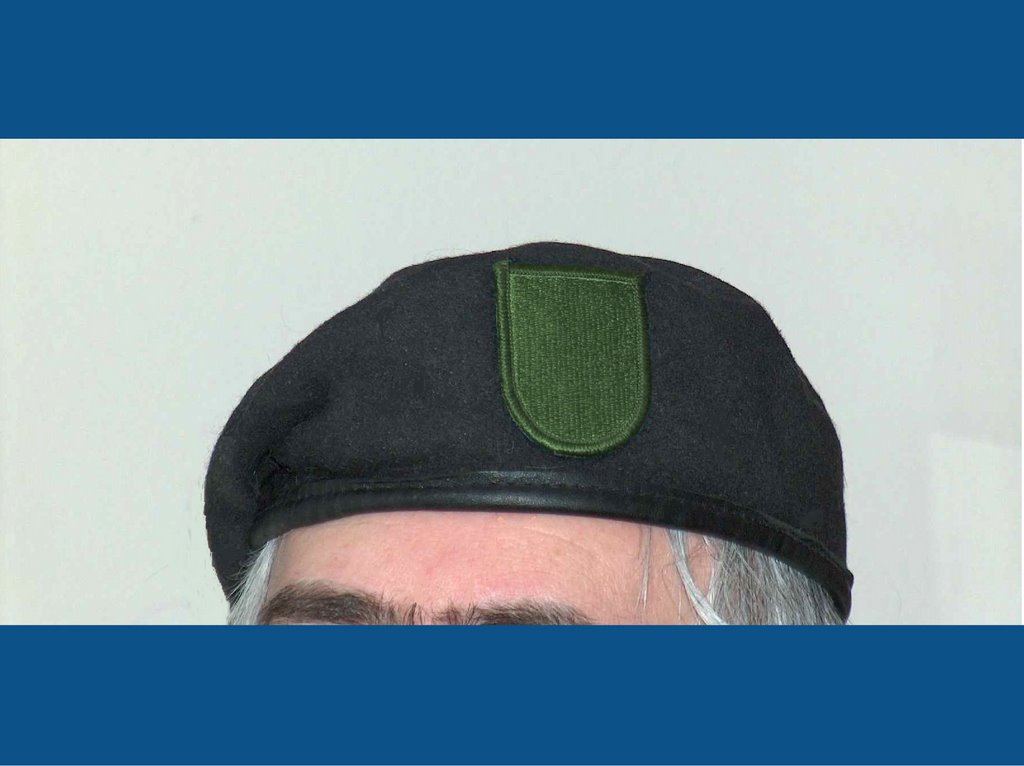
(Those of you who have served in the Army will already know that the shield-shaped patch on the beret is called a "flash.")
Tuesday, December 19, 2006
Coming soon!
Stay tuned ....
Monday, December 18, 2006
Where do I get my ideas for this Blog (and why so long between posts)?
Where I’m coming from
I am (as I’m sure you’ve all noticed by now) NOT a trained theologian or Catholic philosopher. I did attend the University of Washington between 1977 and ’79, studying mostly inorganic chemistry, physics and math, along with the usual “liberal arts” courses expected of every college student, but I lost my ambition to continue in my chosen program and dropped out before completing any degree. I started working full-time then and, except for a 2-year stint in tech school studying electronics and computer hardware in the mid ’80s, I have been steadily employed ever since. I have been relatively fortunate in this regard and I thank God regularly for it.
At present I earn a living for myself, my wife and our three children (aged 11 to 15) in a humble “blue collar” job at a location about 50 miles from home. So each day I have two long commutes during which I am able to think and listen to Catholic radio (we are very blessed to have an EWTN-affiliated radio station in the Seattle area that broadcasts 24-7, KBLE AM-1050). During the course of my work day there is generally quite a lot of time to think as well, since I sit or stand at a workbench most of the time and my assigned tasks do not ordinarily require a great deal of concentration. (Sadly, though, I am not able to receive KBLE’s signal very well inside my building.)
No, I am no theologian by any means. In fact, I’ve never had any formal religious training of any kind since graduating from Catholic high school in ’77 (beyond the odd parish seminar or retreat here & there and “auditing” my then-future wife’s RCIA classes). My “adult” religious education has been entirely on my own, searching out good books and devouring them as time permitted, building quite a formidable personal library in the process. I have also subscribed to several good (meaning faithful to the Magisterium) Catholic periodicals over the years. Many of them I let lapse because I didn’t have enough time to read them, but the three I still keep—and wouldn’t be without—are The Wanderer (weekly newspaper out of St. Paul, MN), This Rock magazine (published by Catholic Answers out of San Diego, CA), and Culture Wars magazine (my personal favorite, out of South Bend, IN). Other Catholic periodicals I could recommend are the Homiletic and Pastoral Review and the National Catholic Register—I’m sure there are many other good ones besides these, but I’ll stop there. Naturally, I have the Catechism of the Catholic Church (1st and 2nd editions) besides numerous other excellent catechisms, as well as a Latin-English edition of the 1983 Code of Canon Law. I also have a 1,914-page Complete Concordance to the Bible (Douay Version) published in 1945 [given to me many years ago by a Protestant friend who found it at a garage sale] which comes in VERY handy!
My ideas
So I have a long history of solid (though informal) Catholic reading under my belt ranging through theology, philosophy, biography & hagiography, spirituality, morality and social doctrine (including very many encyclicals and other official documents), besides my daily doses of orthodox Catholic radio and a lot of time most days to mull over it all. My “default” mental setting is that, since everyone dies sooner or later, and the ultimate goal of every sane person is to get to heaven, religion is the most important topic in the world. (I may have skipped a few steps in that sentence, all you strict logicians out there, but I hope I plotted enough dots for you to at least follow along.) I take my faith very seriously and am always on the lookout for any opportunity to share it, though I try (sometimes with limited success) to conceal my impatience or disappointment with others who do not seem to share my enthusiasm.
Often many days—or even weeks—go by at a stretch, I must confess, when I can’t think of anything worth writing about. Then, sometimes gradually appearing over the horizon of my consciousness like the sun rising on a clear morning, sometimes coming like a thunderclap, I will get an idea and begin to work it over in my mind over the course of several days or perhaps a week or more, jotting down notes on scraps of paper as opportunity affords. It might start as a phrase from a homily or some talk or discussion on the radio, a line or passage from something I’d been reading, or some problem from my daily life or family history that is bothering me somehow. Occasionally it is an event in the news or an article in the secular press that starts me thinking, trying to put it into some kind of meaningful perspective.
I have a rather thick skin, and I don’t have a great deal of patience for those hyper-sensitive personalities who are always afraid of offending anyone. While I recognize the need for a certain diplomacy and tact, a reasonable delicacy or sensitivity to the normal human feelings of others, I also admire brutal honesty and forthright candor. While I always try to acknowledge, understand, learn from and sympathize with other people’s attitudes, beliefs and perspectives on life and various issues, eventually there comes a time when one has to call a spade a spade and “cut to the chase.” Sometimes I go too fast or misjudge the situation and end up turning someone off to whatever it is I’m trying to convey or even blacking someone’s eye (metaphorically speaking of course) by my not-too-gentle way of approaching most things. Sometimes I’m really out of line or off-base in what I say, and I am not afraid to say I was wrong when that becomes evident. But at the same time, I’m not one to apologize or back down from a good argument just because someone out in cyberspace takes umbrage at my legitimate opinion or belief.
I will frequently state Catholic doctrine as established fact, since from my perspective as a convicted Catholic, it is. (If anyone disagrees with or doesn’t understand what I say, I hope he/she would be kind enough to drop a comment or e-mail me to either correct me or allow me to clarify.) I will try to explain and defend such teaching to the best of my ability and show how it is at least reasonable for someone to accept and believe it, but I won’t waste a lot of time beating around the bush trying to convince or win over those who either genuinely “just don’t get it” (after all, faith is a gift from God and we can neither get it nor give it on our own), or who obstinately refuse to shift their own cherished opinions or consider another perspective (there is a qualitative difference between steadfast faith and obstinacy). Contrary to what some people have said of me, I am capable and willing to change or even reject my views and beliefs—if someone is able to find or demonstrate a real (not just an imagined or imputed) weakness or defect in my position or how it is somehow irrational or dishonest to maintain such a belief. I have, at many times in the past, held erroneous beliefs, and once shown their inconsistencies or otherwise unreasonable elements, I changed my view. My faith is not blind or obstinate. I strive at all times to be open to the truth.
The only problem (if you could call it that) is that, so far as established Catholic teaching and Apostolic Tradition are concerned (once they are properly understood), there are no inconsistencies or defects of any kind (since it was revealed and continues to be safeguarded by God Himself). History bears witness to this fact. (On the other hand, the sinful behavior and attitudes of individual Catholics, acting either alone or in groups, is another matter entirely. They sin precisely because they are in violation of Catholic teaching, since it is that teaching that informs us of God’s will, the violation of which is the essence of sin.) For 2000 years, many of the cleverest minds known to civilized man (and not just the moral degenerates) have struggled against the historical, doctrinal, moral and social claims of the Catholic Faith, and have often persecuted, tortured and killed its adherents wherever they could be found. (Quite a few of these persecutors, antagonists and adversaries of the Church eventually converted to the Faith, often led by their own arguments into the fullness of truth, or inspired by the personal faith and courage of the martyrs in the face of torture and certain death.) Many people have sworn to crush, obliterate and bury once and for all the Catholic Church and all memory of her. In the end, all these men have themselves been buried, and today the Church is as strong and vigorous as ever, winning new converts every day from among men and women of all races and backgrounds, the rich and the poor, the wise, erudite and refined, as well as the simple, uneducated and uncouth. The Catholic Church is, in this respect, truly universal.
So the things I write here could be called the ordinary musings, ideas and expressions of one ordinary Catholic layman—a view of the world seen through the eyes of “Joe Pewsitter.”
Sunday, November 26, 2006
Religion Confusion, Part 5
-------------------------------------------
Truth is simply the expression of or correspondence to reality, and God is reality itself. Everything that exists at all, everything that is real, has its origin and sustenance in God.
If anyone is shown the truth and recognizes it as such, and still chooses to reject or defy it, choosing instead to “make his own truth,” he is in fact rejecting God who is the source and summit of all truth. If a person persists in such rejection at the moment of his death, he cannot be saved.
-------------------------------------------
Of the four major religious systems I’ve been discussing, three of them are based upon some book or books. Modern Jews base their religion on the Torah (a.k.a. the Pentateuch), other books of [what Christians call] the Old Testament, or the Talmud (or some combination of these). Muslims base their religion on the Qur’ân (Koran) and other writings about the life and teachings of Muhammad. Protestants base their religion on sola scriptura (the Bible Alone). But none of these “religions of the Book” have a generally recognized living authority that can provide a final interpretation of “the Book” for all its adherents in case disputes arise (which inevitably happens). No written text is capable of interpreting itself or applying its message to the situations and circumstances of everyday life.
Ultimately these all rely on what is essentially a private (or personal) interpretation of a written text, as in “well, the way I read [the text] is this …” or “I disagree with your view; I don’t think you understand [the text] properly …” The adherents of these religions have no living voice to which they can appeal that can say with finality, “I’m sorry, but that particular interpretation of the text [or of our tradition] is invalid, and here’s why …” or “Wait a minute—you have no right to do that, and here’s why …” Their opinions and arguments just go round and round without coming to a satisfactory conclusion. Consequently, every other faction in the group is forced to allow, tolerate or look the other way from every “wacko” interpretation that comes along (so long as it has at least a veneer of plausibility) even if it flatly contradicts other more plausible (and consequently more widely held) interpretations. No one has the authority to stand up and say, “No, you can’t hold that position and still be a faithful member of this group because we don’t believe that.” While such various positions may be fiercely debated, none are ever excluded, and confusion among the faithful (or eventual division) must inevitably result.
The Catholic religion, on the other hand, is NOT based on the Bible (or any other written text)—so that particular accusation made by many Protestants is absolutely true. Rather, the Catholic Church wrote the Bible (certainly the New Testament, but one could say the Old Testament as well if one includes the Patriarchs and Prophets as part of the Church established by God, which the Catholic Church does). The Church is not based on the Bible; rather, the Bible is based on the Church. (It was in fact synods and councils of the Catholic Church that established the canon of Scripture (the Bible’s “Table of Contents”) back in the late 4th and early 5th Centuries.)
Only the Catholic Church has a built-in mechanism for interpreting its own sacred writings. We call it the Magisterium and it is exercised in its fullness by the college of bishops in communion with the current pope at any moment in history. Every Catholic bishop in the world within his own diocese (and every square inch of the world—be it land, water or ice—falls within the jurisdiction of some bishop) shares in this magisterial office for the people entrusted to his care (his flock), and he exercises its fullness with and in communion with the pope. Thus the Church remains One in its profession of faith throughout the world. (Individual bishops have the fullness of this teaching office, but a limited jurisdiction, whereas the pope (a bishop himself) has by definition, in virtue of his unique office (called the Petrine office after St. Peter), universal jurisdiction, and therefore jurisdiction even over other bishops.)
This living teaching office, this Magisterium, is the final authority (the final “court of appeal”) for judging whatever ideas and activities are compatible with the faith or not, or for adjudicating the disputes which inevitably arise over time. Such a single, living authoritative voice is essential for any organization to survive. Every institution needs some kind of “pope,” whether it calls him the CEO, Chairman, Prime Minister, Supreme Potentate or Grand Poo-bah. History bears out this truth. Agreeing to “decide by committee” never works in the long run. Fallen human nature precludes this option. Factions inevitably form even within “the committee” and if their differences aren’t finally worked out the group eventually breaks apart as a result. Nor is “agreeing to disagree” any way to arrive at a knowledge of the truth, but is instead a mutual concession to petty human pride and a tacit admission that truth is relatively unimportant. Jesus Christ, the Way, the Truth and the Life, understood this fact of human nature absolutely, and so said, “Thou art Peter (Kepha), and upon this rock (kepha) I will build My Church, and the gates of hell shall not prevail against it” (Matt 16:18).
-------------------------------------------
OK, now let’s try a different tack.
Whenever anyone sins (be he Catholic, Protestant, Jew, Muslim, pagan or agnostic), he is doing the work of the devil. Everyone is a sinner—even the pope—and so everyone does the devil’s work on occasion. The pivotal question, however, is does he recognize this fact and repent of his wrongdoing, or does he glory in it? Does he turn away from his sin or does he make a career of it?
What is the devil’s work? To sew seeds of confusion, division, conflict, dissention, disobedience, deception and strife among human beings. In other words, doing anything and everything to distract people (oneself and/or others) from pursuing their one true destiny, i.e. the love of God and eternal life with Him.
Truth is one, but error is legion. There is only one true answer to 2 + 2. But there are an infinite number of false answers, and if error is your game, any one will do the job.
There is only one Creator and He sent His Only-Begotten Son to redeem the world, and there is no other means by which one can be saved from one’s sins but through Him (cf. Acts 4:12). He established one Church with the mission to preach His salvation and as the chief means to dispense His grace to the whole world. (I say chief means (not the only means) because, being God, He is not bound or limited by whatever He creates—any more than Michelangelo was limited in any way by his sculptures or paintings—and He can provide any extraordinary means he wishes to deal with any particular circumstance. But He did create the Church as the ordinary means of salvation for the world, and He did so with the expectation that it do the work to fulfill the purpose for which He created it.)
If Jesus is the only way (road or path) to the Father (Jn 14:6), all the devil has to do is nudge you off that one true path. And he’s not particular whether you’re off on the right side of the path or on the left, or off by half a mile or a thousand miles, so long as you’re off the path. There are a million (and more) other paths, and any one of them will suit the devil’s purpose—to keep you away from (or to lure you off of) the one true path.
So here’s what happens. The devil tempts us to sin (although we’re frequently also tempted by the world [money, power, the opinions/approval of others, etc.] and the flesh [pleasures, creature comforts, etc.], and if they are enough to get the job done, the devil needn’t be involved at all, so he just sits back and watches with glee—he only intervenes if he feels he has to). Small (venial) sins are enough at first to turn our heads away from our goal, to cause us to stumble just a few feet off the path. “Yeah,” we tell ourselves, “there it is over there; I can still see the path; I can get back on it at any time.” We’re not too far off the path. We’re still going parallel, we’re still headed in the same direction, aren’t we? The danger is that if we stay off the path (remaining in unrepented sin or obstinate error) for very long, we little by little wander farther and farther away until we reach a point when we realize (or it is pointed out to us) we can no longer see the true path. Then suppose we stumble upon another path, one that’s a little wider and a little easier (cf. Matt 7:13), and we mistake it for the true one …
How am I doing so far? Are you getting the picture?
These myriad religious or philosophical pathways frequently cross one another (i.e. they coincide on certain points of doctrine, outlook or praxis) and some have even been known to cross the true path in places. This shouldn’t surprise anyone.
There is no “lazy man’s way” to salvation. Salvation requires being submissive to the truth, and that is hard work. It requires us to practice humility, patience, gratitude and forgiveness. If we lack any of these virtues, we’ll never make it. And these virtues, like all virtues, are gifts we receive only through the grace of God—we can’t do it, or even start it, by our own power. (The “work” I refer to is our cooperation with and reliance on God’s grace, along with the action of our free wills to do the things He asks us to do (it is only by grace that we have the power to do them—grace always comes first) that we might serve as His instruments of salvation for others.)
These pathways, like all roads, are marked with “signs” that identify them and where they claim to lead. It’s up to us to read those signs to see if they are truly pointing us in the right direction, and to judge whether they might not be inauthentic or “forged” signs (i.e. lying—or at least mistaken—about their claims). Everyone has a “gut sense” for truth (it’s called the Natural Law (cf. Rom 2:13-16) and it operates through a well-formed conscience), and if a person values the truth, God has given him enough tools to seek it out and find it, and recognize it when he does.
In the final analysis, the real reason for joining or remaining in any particular religion shouldn’t be “I feel comfortable here” (as I’ve heard Rabbi Daniel Lapin say, “The purpose of religion isn’t to comfort the afflicted. No! It’s to afflict the comfortable!”), or “I enjoy the preaching (or the singing, or the fellowship, or the social events they sponsor),” but rather, “I follow it because it’s true.” As Jesus stood before Pilate, He said, “For this I was born, and for this I came into the world, to bear witness to the truth. Everyone who is of the truth hears my voice” (Jn 18:37).
I am not a Catholic because it is fun, easy, enjoyable, comfortable, it provides emotional security or the people are easy to get along with.
Let there be no confusion on this point. I am a Catholic because Catholicism is True.
Sunday, October 29, 2006
Religion Confusion, Part 4
This is perhaps the biggest part of the problem (especially in the Western world) since it represents division within Christianity itself which, as we have seen, was intended by Christ to be the definitive witness to the truth throughout the whole world until His return at the end of time.
Indeed, in the generation following the Resurrection of Christ, as the Church was just beginning to set its theological “ducks in a row” (formulating ways to convey the truths of the faith in an ordered and systematic fashion), St. Paul (under the inspiration of the Holy Spirit) made the astute observation that Christ’s Church had, in a mystical (not just metaphorical) sense, all the essential characteristics of a living human body (cf. 1 Cor 12:4-27). The Church, quite simply, is the Body of Christ on earth (and more besides). Christ’s body, once raised from the dead, cannot die again. And so the Church, established as it is by the eternal Son of God to be His presence and witness in the world and to speak with His full authority until the end of time, is indefectible: the Church cannot be destroyed, either from without or from within (many have tried to do so, all in vain), and will stand forever. This is accomplished not by the resourcefulness, ingenuity or efforts of any of her members, but solely by the power of God maintaining her in existence. (Indeed, it has been observed by many a saint that the Church continues to exist, not because of her human members, but in spite of them.)
Christ Himself prayed to the Father, in what is called his High Priestly Prayer (Gospel of John, Chapter 17), for the unity of the Church (Jn 17:9-23; see especially verse 21). He prayed not for Christians as individuals (so any particular Christian can, by his own choosing (free will), sin and fall away from faith in Christ), but rather for the Church as a body, as an organic whole. And if you read this passage carefully, moreover, you will notice that the kind of unity he intends is not merely a cordial agreement on a few points of doctrine, but the intimate unity of the Trinity Itself. Even as Jesus and the Father are One in the bond of love which is the Holy Spirit, so is the Church called to be One. Indivisible, by Christ’s own word!
Is it possible that Jesus Christ prayed in vain to His Father? Is He incapable of keeping His Church unified in the Truth? Did he not already know the shortcomings of man, their weakness, self-centeredness and pride? Didn’t He know what the future would hold? Is He not God? It is absurd to believe in the divinity of Christ, to believe the words of Sacred Scripture, and at the same time to think that the Church He established could ever be divided or destroyed.
So what are we to think of all the Protestant “churches” that abound today? Are modern day Protestants considered “heretics” by the Catholic Church? No, they are not. While some of their doctrines are objectively heretical [i.e. incompatible with Apostolic Teaching], Protestants themselves are not considered heretics since they never held the fullness of Catholic faith to begin with. Theirs is not a formal denial of something they once professed as true. People who were raised Catholic, on the other hand, and who chose to abandon Catholicism for a Protestant denomination are heretics in this formal sense, but most Protestants never knew the truths of the faith firsthand and so cannot be faulted for their separation and God does not hold them accountable for this kind of ignorance. (For this reason the Church prefers the term “separated brethren.”) Most Protestants learned about Jesus and the Bible as children from their parents and teachers and have grown through their lives in the love of God and have benefited spiritually through their fellowship with other Christians. All this is very good!
But there is a fly in the ointment. Through no fault of their own, they lack the fullness of the truth and the means of grace promised by Christ to the members of His Body the Church.
Can Protestants get to heaven? Absolutely! (But so can a pagan who tries to form his conscience and follow it in accordance with the Natural Law (cf. Rom 2:13-16) through his cooperation with the actual graces God sends to every human being which confirm him in the love of his neighbor and guide him to his final destiny of union with God.) Protestants have much more going for them spiritually than the “good pagan,” since they already know and love God and His Son Jesus Christ, revere His Word in the Bible, and have the sacramental graces that come to them through baptism. But by the same token, they have the greater responsibility to follow the graces they have received out of obedience to God’s will (to whom much is given, much more is expected), even if these lead somewhere they might not want to go.
Can Catholics go to hell? Absolutely! Just because someone lives amid the fullness of truth and grace present in the Church, he may not avail himself of these gifts and wind up neglecting the condition of his soul, choosing instead to pursue the fleeting pleasures offered by the three sources of temptation: the world, the flesh and the devil. If he does not repent before he dies, hell will be his final destination.
Be that as it may, objectively speaking there can be only ONE Church in any Biblical sense. Those entities referred to as individual “churches” in the New Testament (e.g. “the churches of Galatia” (Galatians 1:2)) are what today are called local dioceses under their respective bishops—which even Canon Law today calls “particular churches” (can. 368ff). These New Testament churches were founded in various cities by the Apostles and their collaborators in spreading the gospel, and they were all unified in faith, governance and worship; they were NOT some ancient analogue of today’s Protestant denominations, each believing its own set of doctrines and “doing its own thing.”
The One Church must also be the Original Church, the one that was there at the beginning when Peter spoke to the crowd from the upper room (Acts 2), not one that came into existence at a later time. It is a fact of history that every church that is acknowledged as Christian must eventually trace its origin back to the Catholic Church. At some point in time its founders broke away from communion with the Catholic Church (or from some other church that itself broke from the Catholic Church). (The original Church founded by Jesus was known as “catholic” at least by the beginning of the 2nd Century as indicated by the Letter of Ignatius to the Smyrnaeans, ca. AD 107.)
But why would anyone who claims to believe in Christ, desires to follow and obey Him, and who believes in the inspired word of the Bible, want to break away from unity with the Church Christ established? (I am not speaking here of those who were brought up as Protestants, only those who originally broke away.) Jesus told his original disciples that they spoke with His own authority, and that those who refused to listen to the Church were to be considered as heathens (i.e. outside of the Church) (cf. Matt 18:17). St. Paul said that “the pillar and foundation of the truth” was, not Scripture, but “the Church” (1 Tim 3:15). The Bible, indeed, comes to us through the Church. So anyone who says, “I can’t trust the Church, I only trust the Bible,” doesn’t really know the Bible. What he is actually doing (probably without realizing it) is setting himself up as a judge of the Church, favoring his own personal interpretation of certain isolated passages of the Bible as alleged evidence of the defection of the Church from the truth given by Christ and the Apostles. But nowhere does the Bible—even remotely—make any provision for anyone to judge the Church. It’s always the visible Church who passes judgment on her members, not the other way around (e.g. Matt 18:17 and Acts 15, especially verses 19, 22 & 28).
Peter himself informs us, “No one can interpret any prophesy of Scripture by himself,” and that the Scriptures “contain some obscure passages which the ignorant and unstable misinterpret to their own ruin” (2 Pet 1:20; 3:16). It is for the Church as a body (under the authority of Peter and his successors, the popes) to interpret the Scriptures and formulate doctrine (cf. Jn 21:15-17). Individual Christians (even priests and bishops) lack this authority and presume upon it “to their own ruin” and that of anyone else who follows their erroneous teachings. To be sure, individual Christians are strongly encouraged to read and understand (interpret) the Bible, but only by the principles and within the bounds or limits set down by the Church’s ordinary teaching authority (magisterium). They are to read and interpret the Bible with the Church, not “by themselves” (formulating their own novel interpretations that are incompatible with what the Church has already laid out).
So what gives; what’s behind it all? Well, certainly the issue of ordinary human pride comes into play. After all, who really wants to submit to the authority of another person if he can avoid it? But that’s just the point, isn’t it? Jesus knew that no one would obey the Church over the long haul unless he knew he was under a divine command to do so. The temptation to say “I’ve got a better idea: I’ll just do it my way” is just too great for us fallen creatures.
Understanding human nature as He does, Jesus also knew that without a single, living, identifiable, “final authority” for settling the inevitable disputes, anarchy and error would soon erupt and destroy His Church. So He set up his Church with an identifiable and unmistakable visible hierarchy (human structure) with a single living head, and endowed the Church with the gift of infallibility (“the Spirit of truth” Jn 14:16-17) so it could not officially proclaim as truth what is actually false, so no one could say “Gee, I didn’t know.”
But sometimes people have been known to give in to the temptation to intellectual pride and the illusion of moral autonomy and say, “I don’t care. I still say I know better than the Church and I’m prepared to suffer the consequences.” And they do suffer eventually, which is fine for them, but what about the other people around them? Such doctrinal mavericks set a bad example for everyone else, saying by their actions that rebellion is OK after all. This is where the seed of confusion is first planted.
Without going over the whole 500 year history of Protestantism, I think it’s fair to say that it engenders a particular attitude and mindset that says, “I’m my own boss, and I don’t have to follow anyone I don’t want to. Heck, I can read the Bible can’t I? If I disagree with my pastor about what it says, I’ll just walk away and find another church I like better, or even start my own church, just like good ol’ Martin Luther did!” Setting aside the fact that that’s not quite how it went down in the 16th Century, I think this fairly describes what’s behind the “Protestant mentality” at the heart of our American experience. You know, that “rugged American individualism”? It’s partly rooted in the fundamental attitude of the Protestant founders and pioneers (etc.) of our country who figured that “just me and my Bible” was a satisfactory basis for discovering the truth.
But even Martin Luther realized by the end of his life that he’d made a catastrophic mistake when it became painfully obvious that “everyone is now his own pope!” But by then it was too late to close the barn door—the horses had escaped. Once the authority of the Church was jettisoned (in favor of “the Bible alone”), Luther discovered that there was no longer anyone to whom the ex-Catholics (fledgling “protestants”) could appeal to settle disputes of doctrine or practice (since not everybody was going to just settle for his personal interpretations any more than they’d settle for the old Catholic ones) and he saw that the inevitable result was the endless splintering off of denominations we see today. No unity, not even agreement as to what things are “essential” and what things are “OK to disagree on.” There’s nothing in the Bible that says anything like that indicating that such an approach is even acceptable (much less desirable), yet they still claim they only believe what’s in the Bible. Curious, no?
So today we have countless denominations and groups of various sizes—and even a few “lone rangers”—all professing faith in and wanting to follow Jesus, and all claiming the “Bible alone” as their final authority, yet each person surely realizing in the back of his mind that “the Spirit of truth” Christ promised to the Apostles could not be leading them all in such divergent directions, revealing to them all contradictory “truth.” It makes no sense!
And these are just the ones who call themselves Protestant. Adding to the confusion, there are also those thousands of “virtual Protestants” who disagree and demur (dissent) on any number of points of Catholic doctrine, and even dogma (i.e. infallibly defined doctrine that every Catholic is required to believe) yet still publicly claim to be Catholic. Today we call these folks “cafeteria Catholics” (because they pick and choose what they will put on their plate of personal belief, and pass on what they don’t like), but they are in fact “Protestant” in their overall attitude because they set themselves up as the final judge in matters of faith and morals, rejecting the divinely established and appointed public authority of the Church and its chief guardian, the pope.
Of course there are people who will say, “Once Catholic, always Catholic,” but that’s true only in the sense that the character of sacramental baptism is indelible. Since there is only “one baptism” (Eph 4:5), everyone who is baptized is baptized into the Catholic Church, whether he realizes it or not (sorry if that upsets anyone). But we don’t say that every baptized Protestant is Catholic, do we? No, because what they profess is not the fullness of the Catholic faith. True, they profess elements of it, but some truths are missing, some truths are categorically denied and some of the things they believe are entirely false. The religion they profess is a different thing, although they are still connected to the Church by virtue of that baptism and the elements of belief that they still hold in common with Catholic teaching. Their communion with Christ’s Church is, in a formal sense, imperfect. (I will discuss this further in Part 5.)
But what’s the big deal about that? So what? Who cares?
Hilaire Belloc explains why it’s such a “big deal” on page 91 of his book The Great Heresies: “Cultures spring from religions; ultimately the vital force which maintains any culture is its philosophy, its attitude toward the universe. The decay of a religion involves the decay of the culture corresponding to it—we see that most clearly in the breakdown of Christendom today [he wrote this sometime between 1936 and 1938]. The bad work begun at the [Protestant] Reformation is bearing its final fruit in the dissolution of our ancestral doctrines—the very structure of our society is dissolving” [emphasis added].
This is an apt description of the process we know as secularization, a ball that was set in motion by the Protestant Reformation. In my view, secularization is simply the internal logic of Protestantism playing itself out. What we commonly refer to as “the Reformation” was in fact nothing of the sort. It would more accurately be called the Protestant Rebellion. A true reformation (such as was accomplished in the Carmelite order by Sts. Teresa of Avila and John of the Cross in the late 1500s and in the Church at large by the Council of Trent over the course of many decades after it concluded in 1563) is a return to the foundational principles of the organization in question: a Re-Formation. What the Protestants of the Sixteenth and Seventeenth Centuries did (albeit inadvertently) was start a process of rending and fragmenting the Body of Christ. Although Luther never intended to break with the Catholic Church, by refusing to submit to its authority (and I admit that there were most probably serious abuses of that authority on the Catholic side), giving in to pride rather than cultivating humility, he wound up “creating a monster” he was unable to control.
He didn’t do it all on his own, of course. There WAS terrible corruption at work in the members and institutions of both the Church and secular society at the time, and the political situation was a powder keg just waiting for a spark to set it off. The chief civil authority (the emperor) was distracted with fighting the Muslims who were invading Europe through the Balkans and was unable to give the grievances of the German peasants the attention they deserved (etc., etc). Europe was a mess and everybody agreed that something had to be done, but open rebellion never solved a crisis.
Today you have secularists, pagans and all the other non-Christians pointing at (1) the sinful behavior of Christians (always a problem!) and (2) the irreconcilable differences of teaching and belief among the Protestants (both the explicit and virtual types) and saying, “See? If that’s what Christianity is all about, I don’t want any part of it!” Now, it is possible (even likely) that they’d want no part of Christianity even if these problems didn’t exist (and they’re just using it as an excuse not to join), but even so it’s a real good point they make.
Except for one thing: that’s not what Christianity is all about. But with all the conflicting chatter, who can tell, right? It’s a doctrinal “Tower of Babel.” But what should be obvious by now is that Protestantism is conflicting and divisive by its very nature and from its very inception. Catholicism, by contrast, has Unity as one of its four identifying Marks. A Catholic is one who is baptized and acknowledges the pope as the Vicar of Christ, successor of St. Peter, head of the college of bishops, and the visible head of Christ’s One True Church (Christ himself being the invisible head of the Church, His Body). Everyone who is baptized and professes (at least implicitly) the same faith as the pope is a member of the One Catholic Church. That’s not too hard is it?
But if a non-Christian looking at it from the outside is so confused that he can’t tell what real Christianity is, isn’t that just the opposite of what Christ wanted His Church to be? That’s not a “city on a hill that cannot be hidden,” not a “lamp on a lamp-stand that gives light to all in the house” (Matt 5:14-15), but rather an obstacle, a stumbling block, a source of confusion and an invitation for discord, a tacit admission that “if you’re looking for the real truth, you won’t find it here. We’re not even sure ourselves.”
In Europe at the time of Luther the lines between “church” and “state” were much less clearly demarcated than they are in America today. The rejection of the generally recognized authority of the Church led eventually to an erosion of people’s attitudes about authority in general. When legitimate authority is scorned and everyone seizes on an alleged “right” to be his own final judge in all things, the inevitable and unavoidable conclusion is anarchy, where the only “leaders” are the ones with the most guns and the biggest guns (either metaphorical or actual) and the will to use them on anyone and everyone. The only rule anyone understands at the end of this logical trajectory is the rule of force, not the rule of reason, and people get so tired of having the proverbial “gun pointed at their heads” all the time and become so calloused that, at the end of the day, hardly anyone values life or anything else.
Nowadays, road rage is all the rage and juveniles and young adults prowl city streets in gangs looking for someone to beat up, just to amuse themselves. No remorse, no acknowledgement or perhaps even awareness that they’re doing anything wrong; it’s just “fun.” Abortion is considered “normal” and euthanasia is making serious inroads into “mainstream” thinking and attitudes. Death becomes the pat answer to every problem, from financial difficulty and social embarrassment to boredom.
Not that Martin Luther could possibly have predicted this logical trajectory, mind you. It took centuries for it to work itself out, but it did work itself out, and it's not finished yet.
But the One Church established by Christ to be His witness to the truth is always there, still standing like a rock in the storm—the winds of error and the waves of chaos always crashing against it—still telling the same truth it always has, even when no one else is listening or even cares. “Truth? Who can say for sure what is true anymore?” Hmm… How about returning to the One authority established and appointed by God for the express purpose of bearing witness to the truth until the end of the world?
I know it sounds crazy, but it just might work!
Tuesday, October 24, 2006
Religion Confusion, Part 3½
It has been brought to my attention that I may have skipped a crucial step (or two) in my rhetorical process back in Part 1 where I started by talking about truth, and then launched into a discussion of religion, without adequately explaining the connection between the two. I made the unwarranted assumption that the connection was obvious. Sorry about that. Permit me to fill in that blank part of the picture by defining a few terms and connecting some of the dots.
“God” is that entity (whoever or whatever it may be) that we choose to revere and honor above all others. I refer to the Creator of the universe as “God” or “the God” (with a capital G) and anyone or anything else one may choose to so honor as “god” or “a god” (with a small g). Since the four religious systems I’m discussing in this series all recognize the Creator-of-the-universe-God, that’s where my focus is at the moment.
“Religion” is one’s belief system, the way one thinks about and worships God, either by oneself or within a group. I personally feel that, since it deals directly with God, religion is (or should be) of paramount importance in our lives.
“Worship,” as I stated in paragraph 2 of Part 1, is that which is due to God as a matter of simple justice. He created us (as well as everything else we could possibly want or need) out of nothing and sustains us in existence moment by moment. We should recognize that He didn’t have to create us at all, but did so out of pure love. Since it is better to exist than not to, we owe Him a specially elevated kind of respect, honor and gratitude: worship.
I also stated in that same paragraph that God is the essence and source of all truth (or reality). Since He created everything that is real (even our mental abilities to imagine things that aren’t real), and in fact had to pre-exist everything else in order to do so, all reality comes from Him and He has reality as one of His own attributes (since one cannot give what one doesn’t already possess). “Truth” is our recognition of or conformity to things as they actually exist.
“Confusion,” on the other hand, is a failure to recognize truth on some level, and I contend that this is not a desirable condition, and that it is worth a considerable effort to overcome one’s confusion and so approach closer to the ascertainable objective truth about God and the universe.
By “the true religion,” I mean those things God (presumably) revealed about Himself, about us and our relationship to Him, coupled with those practices He (presumably) wishes us to follow in learning about Him and in worshiping Him. I am presuming for the sake of discussion that God did in fact reveal such things to mankind, and therefore that a “true” religion does indeed exist.
Since truth comes from God, and our recognition of truth leads us back toward God, and religion is the way we think about God and worship Him, it is my view that the religion we should want to adopt ought to be rooted in truth. If I can identify aspects of a particular religious system that diverge from truth, then perhaps it is reasonable to conclude that such a system might not be the true religion.
I hope that clears things up a bit.
Thursday, October 19, 2006
Religion Confusion, Part 3
When the visible head of the Catholic Church gives an address at a Catholic university on the subject of the link between faith and reason in which he quotes a Medieval source in an attempt to illustrate the point that recourse to violence for the sake of religion is not rational, the response from the Islamic world is … fire-bombed churches, murdered missionaries and cries of “the pope must die!” Hmm…. What do you suppose that means? Does this make any sense? Is this a good way for Muslims to witness to the truth? My view is that it fairly illustrates that Muslims in general (I am unaware of any substantial condemnation of these violent and aggressive acts coming from other Muslim leaders) are basically unconcerned with the notion of truth or rational discourse.
Violence is man’s usual and typical recourse if he cannot defend his position with reasonable argumentation. If I am looking for the truth about God and man, and Islam is not able to address such things, why should I believe it? Because there is a sword pressing against my throat, or the threat of death by explosion if I do not “submit”? This is not genuine faith, but fear. Truth casts out all fear. (The exact quote is “love casts out all fear” (1 Jn 4:18), but I think it applies to truth as well.) If truth is not one of the objects of Islam, then what is its appeal? Is Islam simply the religion of testosterone?
Writing in the late 1930s, Hilaire Belloc gave an excellent explanation of the history and nature of Islam from a Catholic perspective in the chapter “The Great and Enduring Heresy of Mohammed” of his book The Great Heresies. (I highly recommend this book to everyone.) According to Belloc, Islam was not a new religion. It is in fact a perversion or distortion of true Christian doctrine (that’s what the term “heresy” means). I’ll try to summarize here.
Muhammad was pagan, as was the society in which he lived. He was never a Christian, hence he never had the benefit of the supernatural life of God (Sanctifying Grace) which comes through baptism, nor of experiencing God’s love from inside the Church. (See my posts, Life from the inside (Parts 1 & 2) [Feb. 5 & 14, 2006], and And another thing … [Feb. 19, 2006].) It is also not outside the realm of possibility, given what is known about his early years, that his experience of even natural love was somewhat limited: his father died before he was born and his mother died when he was 6, and it seems he had no older siblings or other close relatives (although reliable documentation is sketchy at best); he was taken in by his grandfather, but he also died when Muhammad was only 8; finally he came under the care of his uncle who was the leader of their clan which was the guardian of the pagan temple in Mecca. It is possible that by his adult years the memory of the warmth and intimacy of love he experienced in childhood may have grown cold and dim. Were this the case, he may have had difficulty relating to the concept of the love of God. Regardless of the reason, love has no part in the relationship between Allah and the Muslim. Islam is divine slavery.
If Muhammad was a prophet, he was a prophet like no other. His actual behavior and circumstances were more like some of the patriarchs and kings of Israel (having political power and many wives) and the judges like Gideon and Samson (waging wars of conquest). In contrast, the actual prophets of Israel and Judah, I think, tended to be unmarried (it’s hard to raise a family on a prophet’s salary!)—I know of only two who were married, Isaiah and Hosea (if I’m wrong here, please correct me). The Old Testament prophets lived under the near-constant threat of persecution and were frequently on the move (on foot, not horseback). Many were killed for their unpopular teachings, calling the people to reform their lives and return to the Lord. According to Muhammad, on the other hand, Prophethood came with “perks”—as Prophet he was entitled to have as many as eleven wives (total) [instead of the maximum of four permitted by the Qur’ân] (most of which were politically motivated to shore up his position by creating family ties with potential rivals), considerable material wealth and absolute political and judicial power.
Muhammad had a reflective turn of mind and an active imagination. He was a merchant and, starting in his teens, traveled far and had dealings with all kinds of people and picked up all kinds of new ideas. He took the Church’s teachings but then adapted them to suit his own sensibilities.
The foundation of his doctrine was the unity and omnipotence of God. The attributes of God, His utter transcendence and personal nature, His creative power, the fact that He is all-good and exists outside of time, the good angels who serve Him, the bad angels who rebelled against Him, the immortality of the soul and its responsibility for its actions in this life, the final judgment—these are all elements of Catholic doctrine that he adopted. But where he departs from it—the central point of his heresy—is an absolute denial of the Incarnation or any possibility of an incarnate God. God is SO transcendent, Muhammad thought, that He couldn’t possibly enter into His creation by taking on a human nature (oh, the shame of it all!). So he eliminated the Trinity altogether (too confusing). Along with the Incarnation went the whole sacramental system, especially the Eucharist and the priesthood. Like every other heresy, Islam starts with the truth and then oversimplifies it. Neither Muhammad nor any of his followers ever developed a detailed theology. He was content to accept all that appealed to him and to reject all that seemed to him too complicated or mysterious to be true.
The root of the problem is that he set himself up as the final arbiter of truth; anything that seemed unreasonable to him, he simply tossed out (or twisted and reshaped into something else more to his liking). Where did he get that kind of authority? He claimed that the angel Gabriel told him it was so. But it couldn’t have been the real Gabriel, because Gabriel knew that Jesus was the Son of God (cf. Lk 1:26, 35), which Muhammad denied. Was Muhammad a fraud, making things up as he went along? That might be a little strong, although it could be the case. Or perhaps he was visited by another angel, a fallen angel (demon), who called himself “Gabriel” in order to deceive him. Or perhaps his “visions” were merely dreams which he misinterpreted and embellished. All three of these possibilities (or any combination, or others besides) might be the case. In any event, in his mind simplicity was the key to everything. And the structure and practice of Islam to this day utterly discourages any deep thought along religious or theological lines.
A large part of Islam’s initial success was its doctrine on social and economic justice. The Graeco-Roman world at that time (7th Century) suffered under ubiquitous slavery, rampant usury and indebtedness, complex and burdensome imperial taxation, the tyranny of lawyers and a meddlesome central government. (Hmm … Sort of like America today.) Muhammad preached a new spirit of freedom and relaxation: upon accepting Islam, slaves were freed, peasant farmers were relieved of their debts and crushing taxation, clerical and imperial discipline were swept away, usury was forbidden, and there was free justice under few and simple new laws that everyone could understand. The intricate tax system was replaced by a simple and straight system of tribute to the Caliph(s) (who succeeded Muhammad’s place of authority after his death). As a result of this arrangement the Caliphs became extremely wealthy and were thus able to carry on the expensive business of war and conquest over an extended period of time. Given the opportunity and probability for success of throwing off such unjust burdens, who wouldn’t want to sign on to such a venture? There was also a certain underlying historical character throughout the whole region of the Middle East of natural conformity, a sort of instinct for obedience to one religious head, which was also the civil head, and a general similarity of social structure. This general character is older than any historical record, and it persists to this day.
Muhammad had the good fortune to marry a wealthy widow (he was around 25 at the time, and she was about 40). From this position of security he was free to work out his visions and enthusiasms and undertook his propaganda. But even as his following grew and his doctrines spread, it was all done in a small and ignorant way; there was never any organization. Everything was undertaken in a haphazard and slipshod manner. The Muslim temperament was never tolerant. It was in the main fanatical and bloodthirsty. It felt no respect for, or even curiosity about, those from whom it differed and was absurdly vain of itself, regarding with contempt the high Christian culture around it. And yet it did not exterminate all those who did not accept the new faith. Why? Because the forces of Islam were still too few to govern by force. In the early centuries, the greater mass of the populations remained Christian, and it was they who preserved the Graeco-Roman civilization which was their heritage, surviving under the surface of Mohammedan government.
Certainly, there are numerous “points of light” (elements of truth) in Islamic teaching (e.g. profound reverence for Mary (Miriam), the mother of Jesus, and the recognition of Jesus’ virginal conception and birth), but, like the laudable passages of the Talmud, we have no problem with these. On those points there is no disagreement, no source of confusion. And, as noted above, these elements were all appropriated from Catholic teaching anyway.) Recent years have shown also how individuals or groups of members of both faiths can certainly agree and work cooperatively on certain issues of mutual concern.
But on the whole, especially in the realm of doctrine, Islam and Christianity are irreconcilable and mutually exclusive on the most fundamental level. These two religions cannot both be true because they flatly contradict one another on the most basic question: Who is Jesus Christ?
Monday, October 09, 2006
Religion Confusion, Part 2
Modern Judaism is a particularly difficult nut to crack. It must be understood that ancient Judaism (the Judaism of the Bible) no longer exists either in its religious or racial aspect. This is a fact of historical record. The Judaism of the Old and New Testaments was a hierarchical religion based on the Law of Moses and the priesthood of Aaron with its performance of various animal sacrifices which could only be consummated in the Temple in Jerusalem. This was the “true religion” up until the day that most of the Jewish hierarchy rejected their promised Messiah, Jesus Christ, around the year AD 30. For the next 40 years, Judaism was a walking corpse. When the Roman Legion razed the Jewish Temple and exterminated the entire priestly class in AD 70, Biblical Judaism simply ceased to exist.
From that time on, what we have is Rabbinical or Talmudic Judaism, a religion based on the commentaries and doctrines of rabbis (non-priestly theologian-types who teach and otherwise lead their congregations in the synagogues), which over the next several hundred years were written down and codified in the Talmud. I am not an expert on the Talmud (and there is actually more than one version, the most commonly used being the Babylonian Talmud), but those who are experts have said that many of its passages flatly contradict the Mosaic Law as given in the Torah (the first 5 books of the Bible), which Jews today claim to reverence. And wherever there is a conflict or contradiction, the Talmud always trumps the Torah. (This is basically what Jesus condemned about the teaching of the Scribes and Pharisees in Mark 7:1-13.) Jewish teaching in the synagogues today is from the Talmud, not the Torah. There are, to be sure, many good and exemplary rules and teachings in the Talmud, but those are not the things that concern us here. What we find problematic are the other teachings, the ones that require the violation of the Mosaic Law and the words of the Prophets (those teachings that “nullify the word of God” (cf. Matt 15:6-9; Mk 7: 1-13)). The Talmud also makes numerous vile and, from the Christian perspective, blasphemous statements about the person of Jesus (Yeshu), perhaps as a way to “inoculate” Jews against conversion to Christianity. (When confronted with these passages during medieval public debates on the Talmud’s contents, the pat answer (if they answered at all) was, “Oh, we don’t mean that Jesus. It’s some other [unspecified] guy named Jesus.” Yeah, right.)
So the Jewish religion we see being practiced today (established ca. AD 70, although its spiritual antecedents go back much farther) is actually of more recent origin than Christianity (established ca. AD 30, although its spiritual antecedents go back much farther), and is based principally on the definitive rejection of Jesus Christ (as if to say, “whoever the Messiah might be, it wasn’t him!”) and any notion of a suffering Messiah who would die in order to free mankind from our slavery to sin. The modern Jewish concept of “Messiah” is strictly and exclusively political, not spiritual, and most (if not all) political revolutions throughout history (e.g. France 1789 and Russia 1917) can be traced in some way to the advancement of this Talmudic Jewish idea of establishing the (political) “Kingdom of God” here on earth through force of arms and under Jewish hegemony. (Perhaps this is what was percolating through Mel Gibson’s mind as he ranted recently while in a drunken stupor.)
What is called the “Jewish race” today is also something entirely different than that which lived in Ancient Israel or Roman Palestine. That ancient race was scattered (deported and resettled) throughout the Roman world after the sack of Jerusalem and the defeat of the Jewish resistance at Masada a few years later. The Jews who survived subsequently (over the course of centuries) either converted to Christianity (at which point they relinquished their identity as Jews), intermarried with the various local tribes among which they found themselves, or were persecuted and killed for their perceived antisocial behaviors. (This last item is not a practice I would endorse or condone; I’m simply saying what happened.) The Jewish race of antiquity was thus “diluted” over time to the point where it essentially disappeared. However there were always pockets of “religious” Jews (i.e. people who kept the rabbinical laws of the Pharisees as given in the Talmud) scattered throughout the Roman and Byzantine Empires and they became disproportionately influential for their numbers in certain localities (chiefly through the use of finance). Although the Jewish “race” no longer existed as such, and the Jewish sacrificial religion of antiquity was no more, still there persisted a group of people that lived a distinct tradition (as codified in the Talmud) in more or less closely-knit communities throughout Europe, Northern Africa and Western Asia that were known universally as “Jews.” [Incidentally, that “race” which today has its political center in the modern state of Israel, its economic center in New York and its cultural center in Hollywood, is actually of Slavic not Semitic extraction (which explains why contemporary Jews/Israelis are generally fairer and look more like Russians, Czechs and Poles than their Eastern Mediterranean neighbors).]
Needless to say, (modern) Judaism and Christianity cannot both be true. I do not hesitate to affirm here that there are many good people who are professed and practicing Jews (Rabbi Daniel Lapin comes immediately to mind), and I do not mean to sound as if I condemn any of them in any way. I also affirm that Christianity is the fulfillment of the ancient Jewish religion. But the modern Jewish religion is an explicit renunciation of the Christian faith. So if we are looking for the one true religion (assuming for the moment that there is one), we cannot have it both ways. If one is true, the other must be false. We owe it to ourselves—and to our fellow man—to find the truth. If we are satisfied to accept the status quo (which seems to amount to an indifference to the truth) then only confusion can result, and that’s not good.